MOLECULAR ENGINEERING ON THE STEPPE
The Biopolymer Revolution – Molecular Engineering on the Steppe
The steppe composite bow is often viewed merely as an ethnographic artifact, yet from an engineering perspective, it represents humanity’s first true composite structure. Thousands of years before the advent of carbon-fiber technology, master bowyers had already developed an Interpenetrating Polymer Network (IPN) that optimized energy storage and release at a molecular level.
The Composite Matrix: Horn, Sinew, and the “Biomatrix”
The structural integrity of the bow is derived from the synergy of three primary materials. This is not simply a matter of layered components, but a hybrid system where the mechanical boundaries of each element overlap.
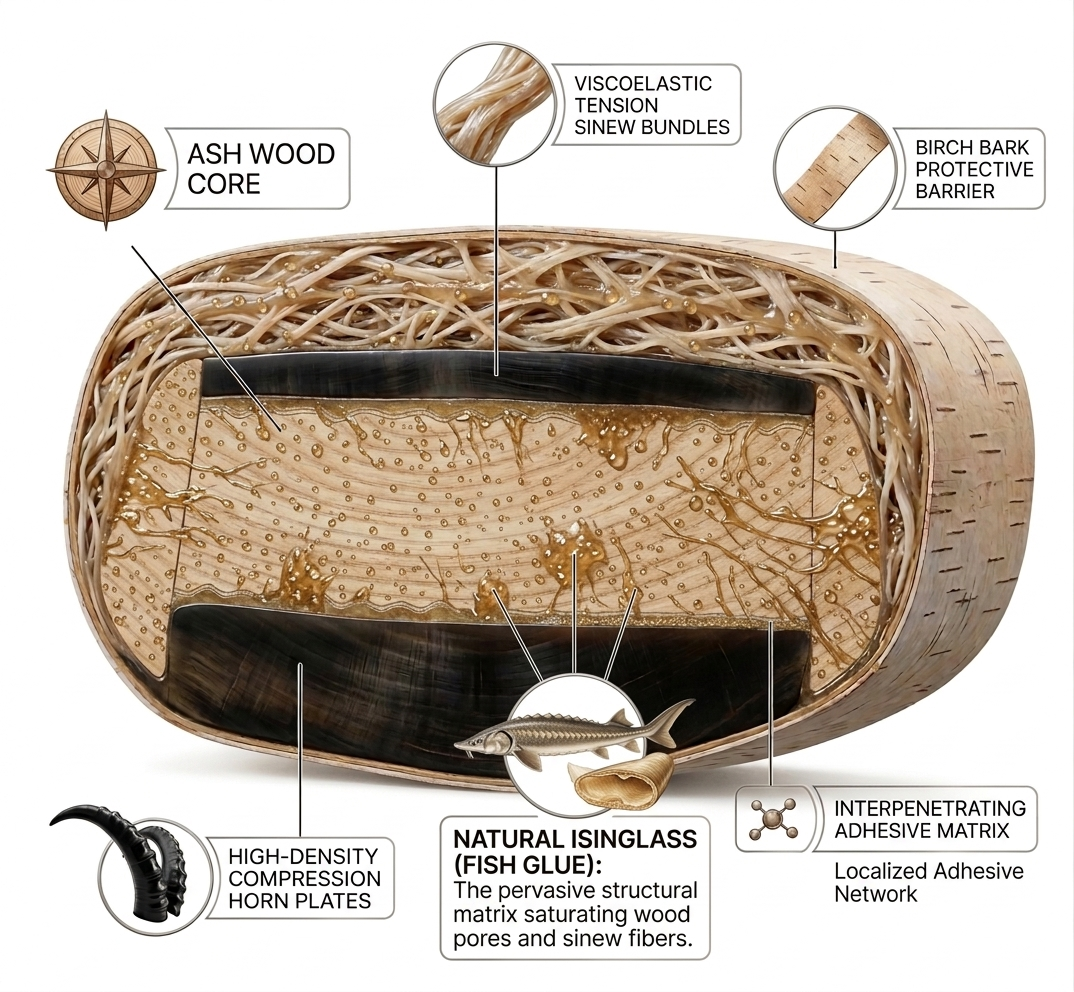
Belly-side Compression (Horn): The side facing the archer utilizes horn (Keratin) from water buffalo or ibex. Keratin is a natural polymer with a compressive strength of 150-200 MPa, rivalling certain metal alloys. At a microscopic level, the lamellar structure of the horn is capable of absorbing immense compressive forces without fiber separation.
Back-side Tension (Sinew): On the outer side, fibers derived from animal tendons (collagen) provide tensile strength. The modulus of elasticity (E-modulus) of collagen fibers allows for an elongation of 5-10% without permanent deformation.
Collagen-based Diffusion (Fish Glue): The adhesive extracted from isinglass (fish bladder) does more than just bond. During the drying process, gelatin molecules penetrate the pores of the wooden core and sinew fibers via diffusion. This creates a molecular bridge between the materials, ensuring that shear forces during the shot cannot delaminate the layers.
The “Pre-stress” Phenomenon: Stored Energy at Rest
The key to the ballistic superiority of the steppe bow is internal tension, or pre-stress. When sinew is applied, the fibers are wet and stretched. During the drying process—which can last up to a year—the sinew contracts significantly, while the horn and wooden core resist this shrinkage.

Scientific Background: This process forces the bow into an extreme reflexed position (a C-shape or even a circle). When the bow is strung, a significant amount of mechanical tension is already overcome. This ensures that the materials operate at the peak of their elastic range, minimizing hysteresis (internal energy loss).